2.8.12

Rugs by Gordon Hull for Anthropologie

When Anthropologie commissioned artist Gordon Hull to design and create a series of outlandish rugs for the gallery space at the retailer's Rockefeller Center store in New York City, the results exceeded expectations. The over-the-top wool rugs are now being sold online, exclusively. Each piece is entirely unique and one-of-a-kind. 


2.11.11

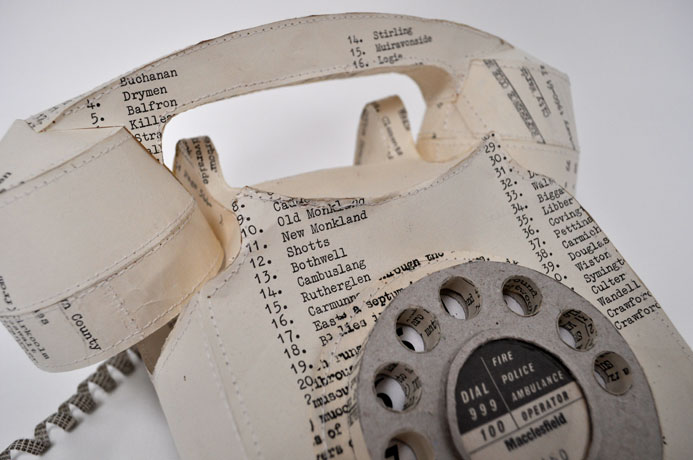
Jennifer Collier: Paper Magician

I had not heard of paper artist Jennifer Collier until a friend of mine sent me a link to her website, knowing instinctively that I would fall madly in love with her creative mind. Based in Stafford, England, Jennifer lets the paper she finds dictate the forms of her creation, using the paper's weight, style, colour and pattern as inspiration and function. "I produce unusual paper 'fabrics' using bonding, waxing, trapping and stitching to explore the remaking of household objects," she writes on her website. Her work has been featured in numerous magazines, including Elle Decoration, Living Etc., Country Living and Selvedge. All of her works are for sale. Visit here for more details. Below are examples of her extraordinary work.


12.9.11

The House of Annie Lennox

London's Victoria and Albert Museum (V&A) is poised to open its exhibit about Annie Lennox, one of my favourites and one of the most influential people in my life. The museum, which touts itself as the world's greatest museum of art and design, will be opening the exhibit called "The House of Annie Lennox" on September 15th, a one-room retrospective of some of Annie's most celebrated music videos, photographs, costumes and charitable accomplishments. The exhibit will examine her creative process, her inspirations, her image and her style. Her Oscar, some of her Grammy and Brit Awards and audio/visual interviews with Annie will also be on view. Below are photographs by Satoshi Saikusa for her first solo album, Diva, which is the album to end all albums in the House of Andrew Ritchie.


17.8.11

Between a Frock and Hard-Place

I love these photographs of Kristina Salinovic taken by Benjamin Lennox for London's Financial Times, November 2010.

14.6.11

Wabi-Sabi Living

The Japanese philosophy of wabi-sabi has long been a fascination of mine. It is essentially the appreciation of - and a longing for - imperfect beauty. Think of a rustic home on a hillside that is made all the more beautiful because of its weathered wood and haphazard planting of wildflowers around its entrance. Or maybe it's your grandmother's old tea pot, with its slightly crackled glaze and the charming chip on its lid. The wabi-sabi ideal is not so much a rejection of 'perfection' as it is a marrying of opposites. The philosophy can apply to any form of aesthetic or artistic pursuit: poetry, painting, design and decoration, all the way through dance and movement.

Some new additions to my library have inspired me to turn my appreciation of wabi-sabi into the art of practicing it at home by living with the things I love without feeling like I am violating some sort of rigid design rule. I am a great lover of old things (books, linens, decorative objects and dinnerware) and it is sad to have those great treasures stored in boxes, out of sight, simply because of the fear that they "do not go with anything." They could and should be enjoyed. The trick is to relax the mind while training the eye to incorporate and appreciate more texture, more colour and more variation into the living environment. These books, which are inspirational on their own, are the perfect guides to wabi-sabi living.
Wabi Inspirations by Axel Vervoort; The Wabi-Sabi House by Robyn Griggs Lawrence; Religion in Wood A Book of Shaker Furniture by Edward Deming Andrews and Faith Andrews; Wabi-Sabi For Artists Designers, Poets and Philosophers; Etcetera by Sibella Court.

25.4.11

A Collection A Day

Maybe it's twine, or vintage postcards, or matchbooks, or those little plastic closures that keep our bread bags freshly sealed: mugs, erasers, elastic bands... Whatever the objects, all things collected are loved by someone. Editor Lisa Congdon (Uppercase magazine) has created a fascinating new book called "A Collection a Day" featuring 365 of her collections of various bits and bobs, lovingly photographed and packaged in a rectangular tin storage box - for the full vintage effect. The introduction to the book was written by Fritz Karch, the collecting editor at Martha Stewart Living magazine. To read more about the project and the book (which is also available as part of an Uppercase book bundle) click here. To order a signed copy of the book (just ordered mine!) as well as some limited-edition ephemera associated with the book, such as limited-edition prints and note cards, click here.

16.4.11

Russel Wright's American Modern

A recent introduction to my purview of housewares is Russel Wright. Considered a modern master, Wright's dinnerware and serveware brought good design to the masses, beginning in the early 1920s through the early 1960s. Unusually curvaceous and deeply coloured in captivating solids, Wright's pieces introduced simplicity to the everyday household. Examples of his colourful and wildly popular American Modern line (considered to be the best-selling housewares line in U.S. history) demonstrate his design aesthetic, which touted the ease of casual living. Wright's primary belief was that the dining table was the heart of the home; his designs stemmed from this philosophy. While much of his most popular work was tableware, he also designed furniture, such as these sleek dining chairs. Wright's firm continues to operate today with offices in Burbank, California and Garrison, New York.